
Caldwell Evolution
  • Home
  • Organizing Services
  • Coaching
    • Evolved Momentum – Productivity Coaching
    • Evolved Momentum – Business Coaching
  • Courses
  • Blog
  • About
  • Contact

Archive for Procrastination

a journal, pen and coffee cup with coffee on an outdoor wood table in the sunshine Graphic of GRWM planning 2026 demonstrating the intention to plan the year.

GRWM: Planning for 2026

Posted by Carolyn on
 December 29, 2025
  ·  6 Comments

a journal, pen and coffee cup with coffee on an outdoor wood table in the sunshine Graphic of GRWM planning 2026 demonstrating the intention to plan the year.It’s planning season and time to plan for 2026 as the New Year looms on the horizon.


I’ve identified four steps to the planning process. While I primarily teach this as a business planning tool, it can be used for planning out any set of goals or dreams you might have. Loosing weight? Landscaping a yard? These for steps apply just as well.  Here we go.

Stepping Out – of your comfort zone

This first step has two parts each with its own function. Both require stepping out of your comfort zone and both will help with planning for 2026.

Part One

The process begins with a review of the previous year. This review not only helps to identify successes and challenges from the previous year, but all provides a stable platform from which to move forward.

Start by taking a piece of paper and dividing it into three columns. Title the first column “What I Wanted” and write down in this column the goals and achievements that you wanted for 2025. The second column is titled “What I Got”. In this column, beside the list of what you wanted, write down what you actually got. You may have achieved your goals or you may have supercharged them. Some of you may be disappointed with the results of some of your goals. Suspend judgement in this exercise and simply write the truth as you see it.

The third column is titled “How did I Contribute to this Result?”. What hard things did you do? Where did you hold back and play small? Here is the out of the comfort zone space for you. Suspend judgement and simply review and acknowledge what you wanted, what you got and how you contributed to the outcome, both positive and negative.

My clients often find this to be a very revealing exercise. In some cases, things didn’t happen because they simply failed to continue as a priority. In other cases, things happened because they worked consistently in the direction of their goals. Recognizing how we contribute to success provides us with tools to move forward into planning 2026.

There may be things you choose to leave behind in 2025. Not everything undone needs to move forward. Leave behind what no longer serves your purposes.

You now have a stable platform from which to work moving forward.

Part Twowhite coffee cup that says begin, sometimes this is the hardest part of decluttering or planning

The second part is a visioning exercise.  I call it the view from the top of the mountain. Other coaches have different names for it but the process is the same. Some call it magic wand thinking!

Close your eyes and imagine yourself one year from now at the close of 2026. What goals have you achieved. What are you doing? Who is with your? How are you feeling? What can you do now that your goals have been achieved? What else did you accomplish? Imagine the tastes, smells, sights, sounds that are all around you now that you have accomplished your goals. Make this vision as vibrant and as detailed as possible.

The world of high performance sport and the research in neuroscience that has followed, has revealed that your brain can’t tell the difference between what you imagined you did and what you actually did. If you imagine yourself getting up and running 5 am each morning for 28 days straight, then when you actually do get up at 5 am and go running, your brain is convinced this is something it has done before. Rather than feeling fear or conflict, if feels familiarity and comfort.

Once you are really clear on what the end of 2026 looks, feels, tastes, smells like, turn around and look back towards the beginning of the year. Look at the path that has brought you to the top of the mountain. What did you accomplish and when? What did you do halfway through the year? A quarter of the way? Three- quarters of the way?

person's feet in black running shoes taking step on stairs. Showing the idea of stepping up.

Stepping Up – to identify the work that needs to be done

This second step requires stepping up to the real work that would need to be done if you are to accomplish your goals. Pull out a calendar. When would the work happen? What else do you have on your plate? Do you have other commitments that might impede your progress? What things might you have to let go? Stepping up includes creating a financial plan for your goals. Match up your financial resources with your calendar so that the funds you need are available when you need them. If you are planning for your business, map out what income and expenses will happen in each month.

Stepping In – to create a plan

calendar open to days of week with blue and orange marker sitting on top, organized time and planning

The third step is where the detailed planning takes place. While its title is “Stepping In”, I like to think of it as “leaning into” the work.  In the Twelve Week Year, Moran and Lennington identify that most people work best with 90-day deadlines. Conveniently that creates three-month time frames. With a clear and detailed vision in your mind for the end of the year, what will you have accomplished at the 3, 6, 9 month markers of the year? Create a detailed plan for the first 90 days. Each subsequent 90 day block is less detailed. You will have a chance to review and revise at the end of each 90 day block for the next three months.

Stepping Through – the gremlins that stand in our way and try and pull us down

woman in brown sweater and scarf sitting on log an looking out over body of water. Showing quiet and thoughtfulness

While planning for 2026 to be successful is essential, equally important is to planning for the gremlins. They will show up. I’ve identified four key gremlins that tend to show up consistently for my clients. They include Fear of Criticism, Fear of Failure, Dislike of a Task, and Impatience. I’ve created a cheat sheet with tricks to conquer all four of the gremlins. Click here for your free copy.

Planning for 2026 success will include a plan for the gremlins. Put this in place a head of time and you are armed for when they show up. You won’t be surprised – you will be prepared. Preparation matched with planning leads to success.


Mindfully I AM Evolving Coaching Planning
Tags : Goals, Planning, Procrastination
the lower legs and feet of two people running on a dirt path. Taking small steps

Big Power in Micro Steps

Posted by Carolyn on
 August 27, 2025
  ·  No Comments

corner of day timer with to-do list title at top of page against blue folder and coffee cup on desk. Power in micro goalsIt started with a challenge…

and ended with using micro steps to accomplish 17 trips from point A to point B over 9 weeks. It would have been 18 if I hadn’t had the flu.

If you have been hanging around this blog for awhile, you know that I coach alpine skiing during the winter.  So what does that have to do with micro steps?

This year, due to maintenance requirements, the coaches’ meeting location was changed from one building (South lodge) to another (North lodge). The challenge was that my boots, helmet, extra gear, skis etc all  live at South. The meeting was called each Saturday and Sunday morning BEFORE the ski lifts opened. Which meant that


Could it be that micro tasks could be even more successful than a daily 15 minute declutter routine? I say yes; I think they can and that we ought to all jump on this bandwagon. Micro tasks could possibly even replace the 15 minute declutter routine.

How it Started

Mindlessly, I was stared at the shelf beside my desk. I had done so countless times before, while thinking through yet another online tech challenge. I have no recollection of sorting out the tech issue. It was clear there were things on the shelf I had not used in years and was never likely to use. In a split second, I decided to clear the shelf, wipe it off and remove to a donation pile those things I would not use. Like the audio CD for learning Spanish. I no longer have a CD player on my computer or portable device to play it.

In less than 5 minutes I had a clean shelf that was now half empty, a small bag of denotable items and a few items in recycling and garbage. The result of my micro task was a very satisfying declutter. The shelf is half empty, clean and can be used more effectively.

Micro Tasks

I soon determined that micro tasks could be done almost anywhere, almost any time. I’ve made a game of it. Just this morning, while waiting on the front door step for my son to load the car before leaving, I clipped back the trailing plants in the planter. The micro task took 5 minutes. Later while waiting for a video clip to upload, I wiped the windows sill, rinsed the stained-glass ornaments, took away the ones I no longer wanted and put everything back. Another 5 minutes.

I’ve defined micro task as a 5-10 minute task that can be completed with little or no additional equipment and contributes to clutter free living. Two days ago I took the ski jackets out of the front hall cupboard, inspected for rips and tears and transported to our off-season storage rack in the basement. I’ve got my eye on a shoe rack with 5 pairs of flip flops that haven’t left the rack in awhile – maybe 2 years. While waiting for the kettle to boil, I can scoop up the flip flops, inspect for integrity and bag for donation. This last task makes use of the concept of time layering along with micro tasks.

The Game

Try it.

  1. Look for 5 minutes either between other projects or activities or while waiting for something else to happen (standing in line)
  2. Look around for a 5 minute task that is super easy to accomplish. For example, while waiting for the pasta water to boil, take the cutlery out of the cutlery tray, wash the tray and replace the cutlery.
  3. Make a game out of finding a micro task that doesn’t require any extra equipment (except maybe a cleaning cloth).
  4. Make sure that the task contributes to either decluttering or getting something done. For example, I filed the top few items on my paper filing pile waiting for yet another video to upload,.
  5. See how many of these you can do in one day.

The Benefit

Five minutes may not seem like alot of time. Those 5 minute tasks, however, all add up. The paper requires filing. The shelf requires decluttering and the flip flops require a new home.  Add all those micro tasks together, all those 5 minute games, and eventually, you have a clutter free house.

Try it, and let me know how it goes.

Organizing Strategies Productivity
Tags : Goals, organizing strategies, Procrastination
desk owner is trying to get things done, pink notebook, pink flowers on white desk,

The Power of Accountability and Body-Doubling for Productivity

Posted by Carolyn on
 September 24, 2024
  ·  No Comments

desk owner is trying to get things done, pink notebook, pink flowers on white desk,Accountability and body doubling are two powerful strategies that can significantly boost productivity, especially for people with ADHD. As a certified professional organizer and productivity coach, I offer both services to help you stay focused and achieve your goals. But which one is right for you?

Accountability involves setting goals and having someone (like me!) check in to ensure you’re staying on track. This service is ideal if you’re self-driven but need external motivation. Knowing someone will follow up can give you that extra push to complete tasks, whether it’s decluttering, organizing, or sticking to new productivity habits.

the lower legs and feet of two people running on a dirt path. Taking small steps

Body doubling, on the other hand, involves having someone physically or virtually present while you work or workout. The body double doesn’t do the task for you but creates an environment of focus and shared energy. It’s perfect for those who struggle with distractions or need that extra sense of partnership—making it particularly helpful for ADHD. It is like having a training partner, whether or not they are training.

3 Key Tips for Choosing Between Accountability and Body Doubling:

  1. 3 women working at a rectangular desk providing each other with accountabilityKnow your work style: If you thrive on independence but struggle with follow-through, accountability might be your best bet. If you work better with someone nearby, body doubling can offer that sense of shared focus.


  2. Consider the task: Simple, straightforward tasks like email sorting may benefit from accountability, whereas overwhelming or emotional tasks, like decluttering sentimental items, may be easier with body doubling.
  3. Experiment: It’s okay to try both! Some people find that body doubling works well for certain tasks, while accountability is better for ongoing projects.

To help you experience the benefits of these services firsthand, I’m offering an introductory sessions free of charge until the end of September. A group is gathering to provide community accountability AND body doubling to help each other get a few things done. Here I the link to sign up — don’t miss out!

Organizing Strategies Productivity
Tags : accountability, body double, organizing strategies, Procrastination, professional organizers
woman with blue beret sitting at cafe table with book and coffee cup leaning on her arms, looking unmotivated

Reasons for Procrastination: And what to do about them

Posted by Carolyn on
 August 12, 2024
  ·  No Comments

woman biting pencil staring at computer looking worried and frantic.The reasons for procrastination vary. I call them procrastination gremlins. Many of us have our own reasons for procrastination or our own list of gremlins. You may be silently thinking of your own.

However, just because procrastination exists, doesn’t mean it can’t be managed. Here are the top four reasons for procrastination that my clients encounter and how to combat them.

Reason 1: Perfectionism

A procrastinator is often a perfectionist. The perfectionist is afraid to start something for fear it won’t be perfect. There is nothing wrong with high standards. They can lead to wonderfully creative and high quality work – IF the “thing” gets accomplished or finished. If, on the other hand, it never get’s started, perfectionism is simply a stumbling block to wonderful work.

The Solutions:

  • The mantra “done is better than perfect” is a great start. Get started to that you have lots of time to make it good enough which is much closer to perfect than not done at all. 
  • Try breaking the project into small enough steps that you can feel great about the standard achieved in each step AND get it finished.

Reason 2: The Task is Overwhelmingpile of black and white photographs in no apparent order

Procrastination can occur when a tasks seems overwhelming. If you don’t know where or how to accomplish a task, it’s very hard to get started or finished. Sometimes even the research to figure out the task or project is too daunting.

The Solutions:

  • Hold off on the research. Write down WHY you want to accomplish the project. What’s in it for you? When the project is finished, what else can you accomplish? This will help to drive up your motivation.
  • Break down the project or task into what you DO know. What would it take to get one step of this project on your to-do list? The research you need to do will be clear.
  • Start research into how to do the project but consider it an experiment. In other words, hold off on any judgement. What you gain is simply information on how to accomplish the task or project. This will help you see the project in manageable chunks while giving you the information you need.
  • Figure out the very first step. Start there. Often, the next step will be clear once you take that first step.

Reason 3: Fear of Criticismwoman sitting on heels on a dock beside a quiet body of water with eyes closed - as if meditating

This nasty gremlin is a distant cousin of Perfectionism. The difference is that in perfectionism you criticize yourself.  Fear of criticism is worrying about what other people might think. You may have real, tangible experience with criticism and feel quite certain that particular people will say something critical and negative – regardless of how well you accomplish the task or project.

The Solutions:

  • Some mindset work can be helpful here. The reality is that you can’t control what or how other people think. You can only control yourself. Try working on a Can Do mindset and recognize that some people will be negative and critical no matter what you do.
  • Focus on what the project means to YOU. What does accomplishment allow you to do? What does completion of the task allow you to do afterward? How will you feel if it is accomplished.

Reason 4: Fear of FailureScrabble letters spelling the word Failure on a wooden background with other random letters around

You’ve tried this project before and never been successful. Or the opposite is true. This is a task or project that takes you way outside your comfort zone and you are afraid you won’t be successful.

This gremlin is cousin to Fear of Criticism and shows up when confidence is low. The task or project maybe too big or unfamiliar.  Skills or knowledge might be missing. And, you are worried what people will think or say if/when you fail.

The Solutions:

  • Try and remember that learning and growth are what happen when we are outside our comfort zone.
  • Break the project or task into small pieces. Make the first step small enough you are guaranteed to be successful.
  • Revisit the WHY of your task or project. Keep your motivation high.
  • Find additional inspiration to take you outside your comfort zone. Maybe you need a hero who has done a similar project or task.

Everyone has their reasons for procrastination. Use these solutions for your procrastination gremlins.

Organizing Strategies Procrastination
Tags : Goals, organizing strategies, Procrastination
person's legs with red running shoes lying on white hammock

Delay and Procrastination: Same or Different?

Posted by Carolyn on
 January 31, 2024
  ·  No Comments

How does one determine whether not doing something is delay and procrastination?

Procrastination is a one of the most common complaints and issues for all my clients whether they are seeking my support for decluttering, down sizing, business or life coaching. Curiously it all looks the same and the concerns are expressed the same way.

“Why do I keep procrastinating when I know I should be doing this (filling the blank with desired goal to accomplish)? Why can’t I just do it?”

Delay vs Procrastination: The Differencewhite balance scale with apples on one weigh plate.

Timothy Pychyl is one of my favourite resources on procrastination. His book Solving the Procrastination Puzzle has been a great resource and provided extremely helpful information.

Pychyl defines procrastination as “needless voluntary delay”. In other words an individual is choosing to delay action on an item, unnecessarily. He points out that other delay may be caused by factors outside of our control, resulting in a frustrating delay. For example we may need to wait for a supply back order to be available before starting on that fabulous DIY project. A delay may be caused by a shift in priorities. Instead of working on the project the weekend the supplies are available, you time is redirected to caring for a sick child. Balancing and juggling priorities is a day to day challenge for most people.

According to Pychyl all procrastination is delay but not all delay is procrastination. Some delay is waiting on another thing to be completed. Delay could activities out of our control.

Someday I Will Syndrome

Then there is the someday syndrome. Goals we have are unspecific. It is hard to accomplish something that is vague. When there isn’t an clear outcome, date and deliverable in place, often there is a lack of accomplishment that goes with the vagueness.

Solutionscalendar open to days of week with blue and orange market sitting on top.

Here are four key solutions that may helping with your delay and something thinking:

  • Write it down. Whatever it is you want to accomplish, get it writing down to make it real and tangible.
  • Break it down. Large vague project are really hard to move forward on. Make the project or item smaller and smaller into pieces and until you are guaranteed to e successful.
  • Schedule the action or project. Most likely unless it is a very small project, you will be scheduling pieces of activity that lead to completion.

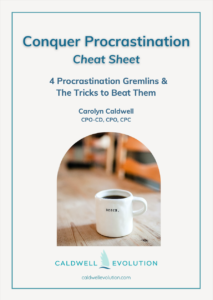
Conquer Procrastination Cheat Sheet cover


For more help with procrastination strategies, pick up a free copy of the Conquer Procrastination Cheat Sheet.


Mindfully I AM Evolving Coaching Organizing Challenges Organizing Time Productivity
Tags : Goals, Procrastination, Time Management, Understanding disorganization
green journal book, key board rose and computer mouse on white desk top to show an organized desk

4 Steps to Planning a Prosperous Year

Posted by Carolyn on
 January 7, 2024
  ·  No Comments

green journal book, key board rose and computer mouse on white desk topSetting up for a prosperous year can be an exciting task. You are at the beginning of another new year and planning is on the brain. Setting up New Year’s resolutions? Have a project you want to accomplish? Is there a particular goal that you are committed to? Or, like my mentoring clients, are you setting up a plan for your business for the coming year?


Ensuring yours is a prosperous year, takes time and a process. Here is a 4-step process from my Planning for Prosperity course that will help you accomplish your goals and projects.

1. Step Out – Of Your Comfort Zone

A prosperous year starts with a compelling vision. A compelling vision keeps you motivated when the going gets tough. It keeps the taste and benefits of success front and centre while you are working through the hard parts of a project or the ups and downs of reaching a goal.  Ask yourself the following questions:

  • Does your project take you out of your comfort zone?
  • What would be the benefit to you of completing the project, task or goals for your year?
  • What will you be able to do when your goal is accomplished?

2. Step Up – To What You have to Do and Whom You must Becomeperson's feet in black running shoes taking step on stairs

For a prosperous year to materialize, we have to be really clear what we have to do and when to do it. In this step, identify exactly when in the year the project or goal activity will take place. Clarify the months, weeks and portion of any day where the activity for this goal or project will take place. This helps you understand what is realistic and what is a “pie in the sky” dream.

Frequently, this is a big “Ah ha” moment for my clients. At this point they realize their income goal is realistic when they can only work billable hours during 42 weeks of the year.

Ask yourself the following questions:

  • Where in your calendar will this happen.
  • How much of each day will I have to earn income, go to the gym or work on my book?
  • How many days a year?
  • How many weeks a year?
  • How many clients are required to earn the income in your goal?

3. Step In – To Identify the Work to be Donecalendar open to days of week with blue and orange market sitting on top.

This step identifies the real clarity of work to be done for your prosperous year. Regardless of your goal or project, what are the milestone accomplishments that you will target? I am a strong advocate for the 12 Week Year by Brian F. Moran and Michael Lemmington. Breaking the goals or project into check in points helps you to see your progress. It also reminds us that each goals or project is best accomplished when broken into steps.

If working on an annual goal, break the year into four, 12 week or 84 day sprints with a 13th week to evaluate your progress and set the next 12 week goals. To help with Step 3, ask yourself these questions:

  • How will I know when the goal or project is accomplished and when?
  • What does one quarter look like?
  • What does one half look like?
  • What does three quarters look like?
  • What metrics will I use to track my progress?

4. Step Through – The Challenges that Hamper Successwoman raising arms in success at tope of hill

A prosperous year is not without its challenges. It’s not a question of IF procrastination, perfectionism, and fear will show up but WHEN. Life will show up and through unpredictable barriers in our way. Having a toolbox of tips and tricks that you KNOW will work for you, will strengthen you ability to accomplish your goals and see your project through to completion.

Ask yourself these questions to help you Step Through life’s challenges:

  • What works for me when fear of failure shows up?
  • Is my vision or image of success compelling enough to keep me motivated?
  • How will I handle criticism from people who don’t share my goals, ambitions, dreams or even understand how important my project is?
  • Is perfectionism standing in my way of success?
  • Can I actually get this goal or project done? Are the pieces or steps small enough?

How you define your prosperous year is up to you. These four steps will help you get and stay motivated, get clarity on the work to be done, what needs to be done and who you have to become to do it. Finally, give yourself some tips and tricks and strategies for when those curve balls get thrown our way.

Mindfully I AM Evolving Coaching Planning Productivity Strategy
Tags : Goals, Planning, Procrastination, Schedule

Getting the To Do’s to Done

Posted by Carolyn on
 September 16, 2009
  ·  No Comments

Third quarter is over and your heading into the final stretch of your financial year. How are you doing on those business goals for your (your choice) a) portfolio b) directorate c) division d) company e) small business?

Getting things done, the old to do list, and making goals are all activities with which we are very familiar. Many of you have even been on courses to try and figure out how to get those goals accomplished so you can meet your targets.

One of the most powerful tools is merely the language that we use to tell ourselves what to do. Try rewriting that list of To Do’s using action verbs that clearly lead to a result rather than vague sentencing of outstanding items to be done. For example:

“Follow up with Jill regarding Great Project implementation” becomes
“Talk to Jill – Confirm implementation and target dates for Great Project have been met.”


Put some power into your To Do’s and watch the Got it Done’s add up.

Organizing Strategies
Tags : Accomplishment, Goals, Procrastination

Someday I Will…

Posted by Carolyn on
 January 5, 2009
  ·  No Comments

person's legs with red running shoes lying on white hammock. Daydreaming about somedayHow often do we use the words “someday I will…” Occassionally? Frequently? Can anyone claim never? Are you suffering from someday syndrome?

Someday No More

I have a colleague who can claim “not any more”. Alex Fayle, a professional organizer used to say “Someday I will live and write in the south of Spain”. Like so many of us he had his share of wishes for another day. Unlike the majority of us, Alex did something about his vague wishes and made them his reality.

Someday Syndrome is not only his story but a resource for anyone suffering from the procrastination syndrome. Does this sound familiar?

  • Someday My Ship Will Come In
    Waiting for, instead of pursuing, your dreams
  • I’ll Get Around To It Someday
    Wasting your life with navel-gazing and other procrastination games
  • I Might Need It Someday
    Filling your life with stuff instead of achievements.

If you have ever suffered from procrastination, even mildly on a bad day, I recommend this read to you. Never was there a better time than the fresh beginning of a year to end those somedays and start creating your amazing life full of acheivements.

Procrastinate No More

Setting a specific time to accomplish actions helps those actions to actually take place. Unless something is scheduled, it typically doesn’t happen. Once something hits the calendar, it has a time commitment that is protected.

Putting actions or goals on a calendar also helps to focus one’s attention on that item Once Alex had committed to moving to Europe (Spain), and put a date to that, he started selling possessions and shedding items to make it a reality.

Write it Downgreen journal book, key board rose and computer mouse on white desk top

Writing down our thoughts makes those one day items tangible and real. Make your goals more tangible and keep them away from that far off, unspecific thinking.

Organizing Time
Tags : Goals, Procrastination, Time Management

Top Five Series – Reasons for Procrastination

Posted by Carolyn on
 November 26, 2008
  ·  No Comments

And you thought you could duck under the radar screen! Sorry my friend, upon review of the posts this year I realized it has been a long time since I confronted the big, ugly enemy of procrastination. Are you a procrastinator? (“Oh yeah” – I can hear you whisper under your breath.)

You are wondering why and what you can do about it? The following list is an adaptation from the book Making Time Work for You, by the Time Guru himself, Harold L. Taylor.

  1. A procrastinator’s view of time is distorted. With 2 weeks before the due date, you think yo have lots of time to get that report finished. The reality is, no where in those two weeks do you have the 9 hours of time free to actually finish the report. The solution: as soon as you know the report is due – book in the time to complete it. Now book in extra time since we both know it will take twice as long as you think it will.
  2. A procrastinator is often a perfectionist. The perfectionist is often afraid to start something for fear it won’t be perfect. The solution: get started to that you have lots of time to make it good enough which is much closer to perfect than not done at all.
  3. A procrastinator often sees tasks as overwhelming. Solution: just do it. Start with any small piece of the project even if it is just five minutes. Break the rest of the project down into bite size pieces that you can manage.
  4. A procrastinator is often someone who thrives on the adrenaline of crisis and deadlines. If you work in the publishing industry you likely have a busy, rewarding life. For the rest of us, it is important to understand that always running late is inefficient, disorganized and often problematic for everyone else around you. Solution: learn to get your adrenaline kick by getting the project done early.
  5. A procrastinator is often just plain disorganized. Some individuals avoid starting projects because they are too disorganized to arrange the information and material they need to get it done. In the meantime, they are still scrambling to find the information and material for the previous project or report which is late. Solution: plan ahead. Plan your year, months, weeks and days by blocking time to accomplish your goals and projects.
Organizing Challenges
Tags : Procrastination, Time Management, Understanding disorganization

Top Five Series – Reasons for Procrastination

Posted by Carolyn on
 November 26, 2008
  ·  No Comments

And you thought you could duck under the radar screen! Sorry my friend, upon review of the posts this year I realized it has been a long time since I confronted the big, ugly enemy of procrastination.

Are you a procrastinator? (“Oh yeah” – I can hear you whisper under your breath.) You are wondering why and what you can do about it? The following list is an adaptation from the book Making Time Work for You, by the Time Guru himself, Harold L. Taylor.

  1. A procrastinator’s view of time is distorted. With 2 weeks before the due date, you think yo have lots of time to get that report finished. The reality is, no where in those two weeks do you have the 9 hours of time free to actually finish the report. The solution: as soon as you know the report is due – book in the time to complete it. Now book in extra time since we both know it will take twice as long as you think it will.
  2. A procrastinator is often a perfectionist. The perfectionist is often afraid to start something for fear it won’t be perfect. The solution: get started to that you have lots of time to make it good enough which is much closer to perfect than not done at all.
  3. A procrastinator often sees tasks as overwhelming. Solution: just do it. Start with any small piece of the project even if it is just five minutes. Break the rest of the project down into bite size pieces that you can manage.
  4. A procrastinator is often someone who thrives on the adrenaline of crisis and deadlines. If you work in the publishing industry you likely have a busy, rewarding life. For the rest of us, it is important to understand that always running late is inefficient, disorganized and often problematic for everyone else around you. Solution: learn to get your adrenaline kick by getting the project done early.
  5. A procrastinator is often just plain disorganized. Some individuals avoid starting projects because they are too disorganized to arrange the information and material they need to get it done. In the meantime, they are still scrambling to find the information and material for the previous project or report which is late. Solution: plan ahead. Plan your year, months, weeks and days by blocking time to accomplish your goals and projects.
Organizing Time
Tags : Procrastination, Time Management, Top 5 Series, Understanding disorganization
Next Page →

Banish those procrastination gremlins!

Conquer Procrastination Cheat Sheet

Struggling with procrastination gremlins? Grab your free copy of Conquering Procrastination Cheat Sheet: 4 Procrastination Gremlins and the Tricks to Beat Them.

This field is for validation purposes and should be left unchanged.
Name(Required)
Caldwell Evolution | Copyright © 2026 All Rights Reserved
Website by Janet Barclay