

Caldwell Evolution
  • Home
  • Organizing Services
  • Coaching
    • Evolved Momentum – Productivity Coaching
    • Evolved Momentum – Business Coaching
  • Courses
  • Blog
  • About
  • Contact

Author Archive for Carolyn – Page 2

desk owner is trying to get things done, pink notebook, pink flowers on white desk,

The Power of Accountability and Body-Doubling for Productivity

Posted by Carolyn on
 September 24, 2024
  ·  No Comments

desk owner is trying to get things done, pink notebook, pink flowers on white desk,Accountability and body doubling are two powerful strategies that can significantly boost productivity, especially for people with ADHD. As a certified professional organizer and productivity coach, I offer both services to help you stay focused and achieve your goals. But which one is right for you?

Accountability involves setting goals and having someone (like me!) check in to ensure you’re staying on track. This service is ideal if you’re self-driven but need external motivation. Knowing someone will follow up can give you that extra push to complete tasks, whether it’s decluttering, organizing, or sticking to new productivity habits.

the lower legs and feet of two people running on a dirt path. Taking small steps

Body doubling, on the other hand, involves having someone physically or virtually present while you work or workout. The body double doesn’t do the task for you but creates an environment of focus and shared energy. It’s perfect for those who struggle with distractions or need that extra sense of partnership—making it particularly helpful for ADHD. It is like having a training partner, whether or not they are training.

3 Key Tips for Choosing Between Accountability and Body Doubling:

  1. 3 women working at a rectangular desk providing each other with accountabilityKnow your work style: If you thrive on independence but struggle with follow-through, accountability might be your best bet. If you work better with someone nearby, body doubling can offer that sense of shared focus.
  2. Consider the task: Simple, straightforward tasks like email sorting may benefit from accountability, whereas overwhelming or emotional tasks, like decluttering sentimental items, may be easier with body doubling.
  3. Experiment: It’s okay to try both! Some people find that body doubling works well for certain tasks, while accountability is better for ongoing projects.

To help you experience the benefits of these services firsthand, I’m offering an introductory sessions free of charge until the end of September. A group is gathering to provide community accountability AND body doubling to help each other get a few things done. Here I the link to sign up — don’t miss out!


Organizing Strategies Productivity
Tags : accountability, body double, organizing strategies, Procrastination, professional organizers
corner of day timer with to-do list title at top of page against blue folder and coffee cup on desk. Power in micro goals

The Successful To-Do List

Posted by Carolyn on
 September 3, 2024
  ·  2 Comments

Looking for the successful To-Do List? Does a successful To-Do List even exist?

Yes, it does. However, there are key factors to make it successful.  Many years ago, I prepared this list of seven factors as part of a “Where are they all” series. Here is how to check off all seven.

1. Are all your To-Do Lists in one place?

Let’s start with how many To-Do Lists you have and where you keep them all. Are they all in one room? Frequently, clients complain they can’t keep track and the lists end up spread out across the house, office or desk.

Put all your lists, if you have more than one, in one place.

2. If they are in one room, are they all in one location in that room?person writing "to-do list" with ink pen on in small note book

Ideally, you use only one, or a maximum of two lists. If you are using two, the first is a brain dump of all the things you can imagine you need to do. This list is a way of emptying your brain and to stop the thoughts from swirling. The second is the short list of things to do TODAY. Give your lists a designated home and make sure they get back there.

3. In that location, are they on one piece of paper, one file, one book or in one file folder?

There is not one single, perfect method to contain the successful To-Do List. There are however, more helpful strategies. I recommend keeping the list in a small notebook. If you identify as a woman or keep a purse, ideally the notebook fits in that purse. It ought to be small enough to carry with you and large enough to keep track of the list, plus any additional to do’s that come up during the day. Using a planner serves the same purpose and keeps the information with your daily activities. It doesn’t matter if this is digital or paper version. Keep it together.

4. Are similar or related items actions listed together?Coaching can support productivity

One of the benefits of writing down the action items, is that related items can be identified. When our thoughts swirl in our head, these feel like unrelated, multiplying action items. Written down, those same items may only be one action with some qualifiers. For example the action item might be “pick up the birthday cake”. The qualifier might be “before 4 pm” or “and dropped off at party venue” or “pick up candles”.

5. Does each item start with a verb?

I call this “verbing up your To-Do List”. Our brains receive clear direction when the action item begins with a verb. If your action relates to getting organized, you might use words like sort, clear, purge, empty, or reduce. Your brain understands the clear action word and knows what to do. Using a verb to start each item removes confusion. On my To-Do List today is “complete weekly blog post on the successful to-do list”.

6. Are your To-Do List items sorted by date identified, date due, level of importance, level of urgency, relevance to your objectives?

Not all to do’s are created equal. Does your list help your brain understand which item to tackle first? Using the 2 list method, the “capture everything” list is just a brain dump of all your thoughts. It can be useful to sort this list by area of your life e.g. work, health and fitness. corner of day timer with to-do list title at top of page against blue folder and coffee cup on desk.The today list represents items that are scheduled for today, are urgent or time sensitive. If you plan your time using time blocking, your to do’s for today are scheduled into the time blocks.



7. Do you know when the items have been accomplished?

An effective goal is one that is clearly measurable. A measurable goal means you know exactly when it has been accomplished. The same is true for the successful To-Do List items. With the birthday cake example above, you know exactly when that item is complete; it’s 4 pm and either you have dropped the cake at the venue or you haven’t. Once again, items written with a verb, and built-in completion details, provide your brain with clarity. These items are easier to accomplish. Accomplishing tasks is faster when your entire To-Do List is built with clear action items.

The successful To-Do List is easy to keep track of, easy to follow and contains clear, actionable items.  “Verbed up”, your brain receives clear information about what it needs to direct you to do and when that task is done.

Clarity Organizing Strategies Productivity
Tags : Goals, Lists, organizing strategies, Time Management, To Do List
woman with grey hair at head of dinner table with family

Siblings Help a Parent Downsize

Posted by Carolyn on
 August 21, 2024
  ·  No Comments

When siblings help a parent downsize, all kinds of interesting things happen. Mostly often, family dynamics come to play and life can get complicated. However, its doesn’t need to be difficult.

The Parent Downsize Backstorywoman with grey hair drinking tea and taking to younger woman as if talking about downsizing

Both my significant other (SO) and I have had parents downsize in the past 10-12 years. My own father passed away four years ago and my siblings and I resolved that estate together. My mother-in-law (MIL) has recently given up housekeeping and moved into an assisted living, retirement environment. While she left the family home over 11 years ago, there was much to pare down from her apartment. Since my SO is one of 6 siblings, there was lots of discussion over the paring down.

How do Siblings Help a Parent Downsize?

Is there a perfect or best way for sibling to help a parent downsize? The simple answer to this is “no, there isn’t”.

There are, however, several good ways. Typically the challenges arise around location of the siblings relative to the downsize location, the number of siblings and decision-making strategies and the fairness of dispersing objects. Where there are many siblings, inevitably at least two want the same picture over the mantel. Another scenario is that one or more siblings want nothing – along with nothing to do with the project. Then others – or usually one other – is left carrying the full load of supporting the parent(s).

Professional organizers see these issues so often is it commonplace. While each family feels like its issues are unique, most of the projects have some very common themes. Here are some ideas to help you through the process.

Who Runs the Show?woman in blue shirt making a phone call as if talking to parent about downsizing

Ideally, one sibling will take lead. This may be the first point of conflict; which sibling will that be? The one that’s closest or has the time tend to be the winners.

Alternative, if several sibling want leadership roles, divide up the downsize into sections. Siblings take responsibility for the section about which they are most passionate. One might be concerned about family photos. Another might be concerned about jewelry and a third about books or dishes. Still another might have strong feelings about the movers, packers or using a professional organizer to assist.

When one or more siblings are geographically located away from the downsize.

The challenge here is to keep everyone informed. Regular checkins using FaceTime, Zoom, WhatApp chat, audio or video all help. if you are sending pictures, do them by category and in small groups. Use the edit function in your photo app on your phone to have the distant sibling identify those items they are interested in or have questions about. The great thing about photos is they can also be grouped by Albums so each siblings interest can be slotted into a separate album.

Who Get’s What?family members gather around laptop for meeting to discuss helping parent downsize

Whether resolving an estate resolution or a helping a parent downsize, how do families decide who get’s to keep what? There are inevitably items that are being shed by the parents or in the estate. That is the definition of downsize. Finding a reasonable way to distribute is challenging at best. Here are a few strategies to try:

  1. The parent has previously decided and the decision is imbedded in a will or list or items have already, previously been marked. This is the easiest. Tip: remember that once an item has been “gifted” it is there to do with as they wish, included shedding themselves. The general rule of thumb is “if you don’t want what Mom has given you, please let the siblings know so that if someone else wants it they can have it.” This sometimes lead to “swapping” which often works well.
  2. The items to be shed are given an overall financial value (fictitious or real. This strategy works best when it is close to the real value). Each sibling is given fictitious funds, a percentage of the total based on the number of siblings. If the items being reallocated equal $1,000 and there are four siblings, each sibling is allocated $2500. Finally each person identifies the items they would like to have equalling their $2500. Where there is competition, try swapping. Last resort there is always a game of “rock, paper scissors”.
  3. None of the items are valued. Instead, distribution is done on the basis of emotional attachment. Each sibling identifies those items in which they are interested ranked 1st, 2nd, 3rd etc. Swapping and trading is done only where there is competition for the same item at the same rank.

Last Items

After siblings have been allocated their pieces, offer the rest to friends or family. These individuals are far more likely to be emotionally related to the items than anyone on the open market. What is left can be sold at auction (live or online), sold in the open market (Craigslist, Kijiji, Facebook Marketplace) donated to charity, offered to the up-cycle market or – last resort – discarded to recycle or landfill.

I have seen all strategies 1 – 3 used in several families over the years. In my experience, the most successful are 1 and 3. The second strategy works, but is problematic as siblings compete for dollars.

Siblings who want to help a parent downsize are often met with frustration and lots of work. In my experience, however, they are also met with tremendous gratitude on the part of their parent(s).

If this is your next project, good luck and let me know how it goes.

Downsizing Move Organizing Organizing Strategies
Tags : Accumulation, Clearing Clutter, Downsizing, organizing strategies, professional organizers
woman with blue beret sitting at cafe table with book and coffee cup leaning on her arms, looking unmotivated

Reasons for Procrastination: And what to do about them

Posted by Carolyn on
 August 12, 2024
  ·  No Comments

woman biting pencil staring at computer looking worried and frantic.The reasons for procrastination vary. I call them procrastination gremlins. Many of us have our own reasons for procrastination or our own list of gremlins. You may be silently thinking of your own.

However, just because procrastination exists, doesn’t mean it can’t be managed. Here are the top four reasons for procrastination that my clients encounter and how to combat them.

Reason 1: Perfectionism

A procrastinator is often a perfectionist. The perfectionist is afraid to start something for fear it won’t be perfect. There is nothing wrong with high standards. They can lead to wonderfully creative and high quality work – IF the “thing” gets accomplished or finished. If, on the other hand, it never get’s started, perfectionism is simply a stumbling block to wonderful work.

The Solutions:

  • The mantra “done is better than perfect” is a great start. Get started to that you have lots of time to make it good enough which is much closer to perfect than not done at all. 
  • Try breaking the project into small enough steps that you can feel great about the standard achieved in each step AND get it finished.

Reason 2: The Task is Overwhelmingpile of black and white photographs in no apparent order

Procrastination can occur when a tasks seems overwhelming. If you don’t know where or how to accomplish a task, it’s very hard to get started or finished. Sometimes even the research to figure out the task or project is too daunting.

The Solutions:

  • Hold off on the research. Write down WHY you want to accomplish the project. What’s in it for you? When the project is finished, what else can you accomplish? This will help to drive up your motivation.
  • Break down the project or task into what you DO know. What would it take to get one step of this project on your to-do list? The research you need to do will be clear.
  • Start research into how to do the project but consider it an experiment. In other words, hold off on any judgement. What you gain is simply information on how to accomplish the task or project. This will help you see the project in manageable chunks while giving you the information you need.
  • Figure out the very first step. Start there. Often, the next step will be clear once you take that first step.

Reason 3: Fear of Criticismwoman sitting on heels on a dock beside a quiet body of water with eyes closed - as if meditating

This nasty gremlin is a distant cousin of Perfectionism. The difference is that in perfectionism you criticize yourself.  Fear of criticism is worrying about what other people might think. You may have real, tangible experience with criticism and feel quite certain that particular people will say something critical and negative – regardless of how well you accomplish the task or project.

The Solutions:

  • Some mindset work can be helpful here. The reality is that you can’t control what or how other people think. You can only control yourself. Try working on a Can Do mindset and recognize that some people will be negative and critical no matter what you do.
  • Focus on what the project means to YOU. What does accomplishment allow you to do? What does completion of the task allow you to do afterward? How will you feel if it is accomplished.

Reason 4: Fear of FailureScrabble letters spelling the word Failure on a wooden background with other random letters around

You’ve tried this project before and never been successful. Or the opposite is true. This is a task or project that takes you way outside your comfort zone and you are afraid you won’t be successful.

This gremlin is cousin to Fear of Criticism and shows up when confidence is low. The task or project maybe too big or unfamiliar.  Skills or knowledge might be missing. And, you are worried what people will think or say if/when you fail.

The Solutions:

  • Try and remember that learning and growth are what happen when we are outside our comfort zone.
  • Break the project or task into small pieces. Make the first step small enough you are guaranteed to be successful.
  • Revisit the WHY of your task or project. Keep your motivation high.
  • Find additional inspiration to take you outside your comfort zone. Maybe you need a hero who has done a similar project or task.

Everyone has their reasons for procrastination. Use these solutions for your procrastination gremlins.

Organizing Strategies Procrastination
Tags : Goals, organizing strategies, Procrastination
desk owner is trying to get things done, pink notebook, pink flowers on white desk,

Simplify: More than Minimalism and Shedding

Posted by Carolyn on
 August 7, 2024
  ·  No Comments

Recently, I had an opportunity to simplify a few things in my own life. With a volunteer term completed, I transitioned responsibilities over to my successor. Although still in a related volunteer role, I was relieved of a handful of duties. My calendar was emptier and my time freer. That’s when I realized that to simplify is more than simply shedding or trying to minimize the stuff in our lives. It is also a key step in getting and staying organized.

The Difference: Simplifying vs Sheddinglarge male deer with a 10 point rack of antlers

In the world of professional organizers, shedding usually means releasing or letting go. Just like male deer shed their antlers before the winter, and make room for a stronger rack to replace it, so do we shed items that no longer serve us. We let go of things we don’t use, like or need. Or sometimes to make room for something better.

Simplifying on the other hand, is more about making things easier. Processes get simplified to with less steps to make them easier, more manageable or shorter.

I once had a client who needed support decluttering and setting up an office after a move. In that process we also simplified the space and workflow so that everything the client needed to work with on a day-to-day basis was within arms reach, or certainly a short swivel chair swing (technical, organizer term “chair swing”) of her work space.

What About Minimalism?

Minimalism on the other hand, is about shedding a lot of things. It really answers the questions “how much can I do without?” or “how can I so more with as little as possible?”. Not everyone is happy to even attempt minimalist thinking or living.

Behind the Scenes

While it is true, having completed my volunteer position term, I was shedding duties and handing them to my successor. And that felt like simplifying things.

However, I had also been reviewing digital files and moving some to our shared online filing cabinet. While shedding the files in one part of the digital world, I was streamlining in another part.

The great part about shedding is it leaves space of new things. I now had time and space in my calendar and business life to refocus back to this blog, my newsletter and having some fun on social media.

Shedding, Simplifying and Organizing

It takes all three to get and stay organized. Try these tips to get you started:hat, coat and straw bag hanging on wall hooks

  1. Start with shedding. Be the deer in late fall and shed what no longer serves you, what will hinder your progress in your goals or what you no longer use.
  2. Once the shedding is done, how can your work flow or processes be simplified? How can steps be reduced to accomplish the same goal. For one client, I simply mounted 2 removable hooks on the wall beside the outside door of the kitchen. One was for her daughter’s lunch bag the other was for the coat.  These hooks completely simplified the “what to do with the lunch box/coat” after school. She would simply move the hook up as her daughter grew.
  3. Finally, ensure that each item has a home. This home needs to be easy to access (retrieval) to easy to put the item back (storage). When storage and retrieval are easy, you’ve likely simplified and will be able to stay organized.
Declutter Office Organizing Organizing Strategies Organizing Time Productivity Uncategorized
Tags : Children, clothes, home office, minimalism, organizing strategies, simplify
Toddler with headphones smiling at camera.

Organize to Music

Posted by Carolyn on
 August 1, 2024
  ·  No Comments

Woman with headphones looking at phone while sitting and patting dog.I frequently encourage clients to organize to music. Put together your favourite playlist. Now see what can be accomplished before the 15 minutes playlist is done.


Bring in a Mel Robins podcast and  boom! My theory has been pushed to the level of science based tools for not only organizing but focus, performance and healing. I highly recommend you listen to the entire show but for now, here is the summary.

Organize to Music for the Tough Stuff

When you listen to music that you associate with great times as a child or young adult, Your brain naturally relates to the mood and feeling of the time and place where you were regularly listening to that music. Favourite high school song? Special song when you and your life partner first met? THAT summer camp song? You know the ones…this the music that you know by heart and when it comes on the radio your mind goes immediately to that time, place and feeling.

Tip 1Toddler with headphones smiling at camera.

Use the music to get through tough organizing. Since this music is guaranteed to put you in a great mood, use this for tackling a tough organizing project. The music will put you in a good and help you get through the tough stuff. Doesn’t have to be limited to organizing to music. My family had an ABBA record that was essential for tackling the Christmas dinner dishwashing at the farm.

Tip 2

After a tough organizing project, use your favourite memory music to reset your mindset. Clearing a loved one’s estate? Left feeling blue and discouraged? Put on your favourite memory music and it will immediately help reset your mindset.

Music for Performance

Have you got a favourite pump up song? If you were being announced on stage, what “walk on” song would you use? What music hypes you up? This music is actually helps you deliver better performance. Whether you listen to it before you have to perform or while you are performing, it will have the same result.

Tip 3

If you are getting ready to tackle an organizing project that is going to require a high level of energy (packing, moving, that over the top full garage?) put on your personal hype music. This music will put you in a state of peak performance and you will get more done. Need to be on top of your game? Put on your “walk on” song and use that increase in energy to get the results you want.

Music for Concentrationblack and white old photos in pile on table

Ever hear of music with binaural beats? This music helps with concentration.  However, you need to be using headphones. Bi means two, right? Aural relates to hearing and ears. Therefore, two ears for two different frequencies that helps you brain into focus, calm or creative thinking. Organizing to music is not just for upbeat. In addition, it can be used for focus and concentration.

Tip 4

Put on some headphones and find a tract of binaural beats to help you when concentration or focus are key in your organizing project. An example might be sorting paper (tax files?) or books where you have to think about what you need to keep.

So, organizing to music is a real, science backed strategy. I highly recommend you listen to the entire podcast in order to hear the full science conversation. And then get your playlists ready and organizing will be easier, more fun and more productive. Have fun.


Organizing Strategies Productivity
Tags : Clearing Clutter, managing mess, organizing strategies
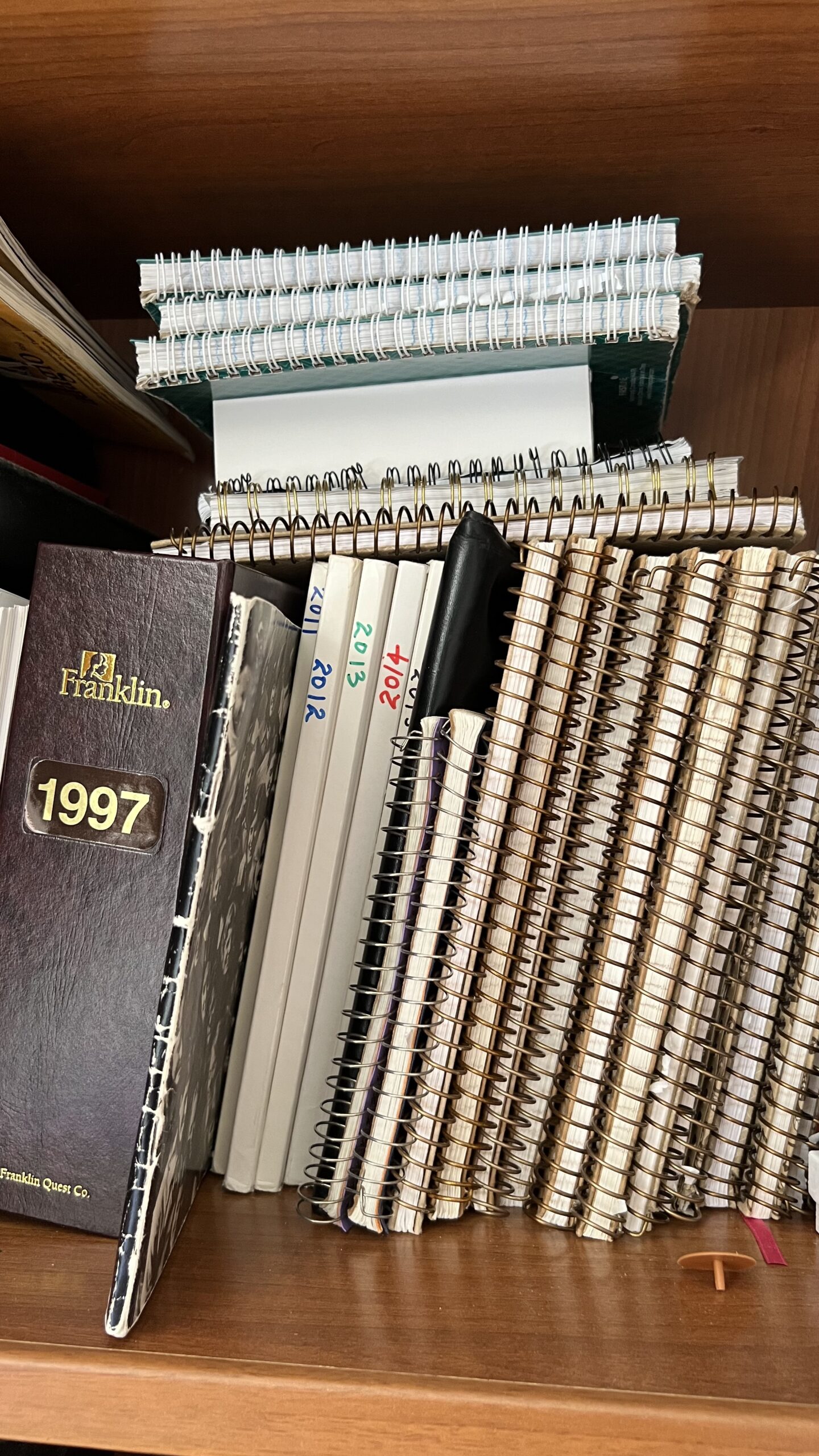
brown daytimer binder with 1997 on spine beside several spiral notebooks on shelf

POV: The Hidden Cupboard of History to Declutter

Posted by Carolyn on
 July 24, 2024
  ·  No Comments

As a dual-certified professional organizer, I’m often expected to have it all together. But the truth is, I’m human, just like my clients. I struggle with the same emotional attachments to stuff that make it hard for others to let go. As a result, I have stuff and history to declutter.

We All Struggle to Declutter brown daytimer binder with 1997 on spine beside several spiral notebooks on shelf

This past week on Instagram, I have been sharing some of the areas of clutter where I struggle. Today I shared a sneak peek into my own desk cupboard, where I store old Day-Timers and notebooks. It was a moment of vulnerability, and I was surprised by how many of you resonated with it! It seems we all have our own secret stashes, struggles and yes, some history to declutter. Like many of you, I find it hard to part with these items, each holding a piece of my personal and professional life.

One of the key messages I want to convey in my POV series is that as organizers, we are human too. We face the same challenges as our clients. But here’s the thing: as a professional organizer, I have the strategies and skills to tackle these challenges. However, the question is – do we use them?

Take Action

After posting today’s reel, I felt inspired to tackle this project head-on. Action is forward movement and progress can’t occur without it.  Armed with determination and my trusty organizing strategies, I dove into the decluttering process. I filmed the process and tomorrow I’ll share a follow-up reel to show you the result.

Set a Time Limit

This was not a scheduled project, and I already had a full list of To Do’s for the day. So, I set a time limit: I would see how much I could do in 30 minutes. This had an added benefit; I knew based on the timeframe of the day-timers that there were emotionally charged items.  The time limit gave me permission to slide past anything that might be too emotionally charged to tackle in the time I had available.

The Decluttering Processred sand draining through clear hour glass

Here’s how I approached the decluttering of my cupboard:

  1. Assess the Contents: I took everything out of the cupboard to see exactly what I was dealing with. This step is crucial in understanding the scope of the project.
  2. Sort and Categorize: Next, I immediately put back anything I knew was an emotional rabbit hole. Let me tell you – it was a journey! I glanced through years of appointments, and schedules. I relived memories, cringed at outdated goals, and even found some treasures I thought were lost forever. As I worked through the stack, I realized that some things were truly worth keeping – like notes about the start of my business. But most of it? Well, let’s just say I won’t be needing those old voice mail notes from 1997 anytime soon.

The Aftermath

Afterward, I’m left with a decluttered cupboard, a huge stack of paper that’s destined for the burn pile (more therapeutic than shredding), and a few treasures to pass along to new homes. Three binders and a portfolio are looking for a new owner – anyone interested?

The Lesson

Decluttering and organizing aren’t about being perfect; they are about being intentional. Recognize what’s truly important, let go of the rest, and create systems that support your goals. Create space for what truly matters. It’s a constant process, and even I need a constant reminder.

Moving Forward

As a professional organizer, I know the strategies. But as a human, I need to apply them just like everyone else and remember to have self-compassion when things get tough. And that’s okay.

I hope this inspires you if you also have some history to declutter in your own space. Stay tuned for tomorrow’s reel, where I’ll share the decluttering process and more tips for tackling your own paper clutter.

And remember – progress, not perfection.

Action Declutter Office Organizing Organizing Challenges
jumbled collection of many dishes on table

Backlog vs Day-to-Day: What’s the declutter difference?

Posted by Carolyn on
 July 17, 2024
  ·  No Comments

Jumbled collection of dishes waiting to be decluttered.Many people don’t realize there is a declutter difference between backlog and day to day. Not all clutter is created equally. This will help.



The Declutter Dilemma

Touch it once. Deal with it now. Don’t put it down put it away.

These are all great organizing principles. EXCEPT they only apply to day-to-day decluttering.

If you are dealing with a backlog these strategies will have you frustrated, overwhelmed and a victim of decision fatigue in no time. UGH!

There is a declutter difference between the two type of organizing. One, clearing a backlog, is all about managing large amounts of material as quickly. On the other hand, managing paper, clothes, dishes or documents on a day-to-day basis is quite a separate process.

Here are some strategies that will help you manage the declutter difference and get your space organized to feel calmer and back in control.

Declutter the Backlogwhite coffee mug with "begin" sitting on wood grain table. Sometimes just beginning is hard with a backlog to declutter.

You have a large amount of material to be reviewed, sorted, purged and then organized. Welcome to the backlog. Perhaps you are preparing for a house or condo sale, or maybe a move. Or, you simply have decided you need more space and less stuff so it’s time to take action.

  1. Key Decision: The key decision for backlog is Discard or Keep. Make this decision as quickly as possible. Simply decide what is shed vs what is keep.
  2. Make it Easy: If it’s paper you are sorting, have a recycling and shredding bag or box right beside you. Anything to keep is divided into FILE or ACTION.
  3. Next Steps: Once this first sort has been done, you will likely find only 10-25% of the original pile is actually left with ACTION to be taken. Take out the recycling. Set up your shredder or find a local shredding company and pick a time to get the shredding out of the house.
  4. Last Step: Take the necessary action and then FIND A HOME for the items to be kept. If you are moving, that might mean packing. Having decluttered already, you will be packing and moving much less.

Managing  Day-to-DayDesktop with keyboard, book, magazine and a sign that says To Do. If your day-to-day decluttering has to do's of less than 15 minutes, try and do them right away.

The decluttering difference with day-to-day organizing is to make sure the backlog never happens. The trick is to avoid an accumulation of belongings or paper, so that you don’t have to take the time or energy to ever clear the backlog.

  1. Key Decision: The key decision for day-to-day organizing is “What action needs to be taken?”
  2. Make it Easy: If the action to be taken requires less than 15 minutes, try and do it right away. Although this is not always possible, getting into the “do it now” attitude for those quick tasks will keep the clutter at bay. This is where “touch it once” makes sense.
  3. Next Steps: Once the action is taken, the following question is “Where does this need to live?”. Every item needs to have a home where it can be easily stored and retrieved.  Remember, however, once the action is taken, where it needs to live might be the recycling, shredding or garbage.
  4. Last Steps: Put the item in its home. This is where “don’t put it down, put it away” comes in.  You are done.

There is a decluttering difference between clearing a backlog versus maintaining a clutter free home or office on a day-to-day basis. Not all clutter is created equal. A different strategy is needed whether you are clearing the backlog to downsize or managing today’s mail. Have fun and keep going.


Declutter Habits Move Organizing Organizing Challenges Productivity
Tags : Accumulation, Clearing Clutter, Downsizing, managing mess, Organizing Maintenance, organizing strategies
orange/red full moon over leaves of forest or garden

Summer Solstice and Full Moon

Posted by Carolyn on
 July 8, 2024
  ·  No Comments

orange/red full moon over leaves of forest or gardenWith both the Summer Solstice and a Full Moon, the last weeks of spring promise renewal. The beginning of summer is a time for Mother Nature to bring rebirth to her garden.Try these three easy tips to help you take advantage of that renewal energy.


Evaluating Before Summer

Tip 1

For some people, the Summer Solstice marks the midpoint of the calendar year. This is an excellent time to reflect on what’s working, what’s not and how far have you come to the goals to which you strive for the year.

For others, the end of June marks the close of a fiscal year end. Evaluating what has worked and what has not for your business will help set you up for success during the next fiscal year.

hands cupped as in a bowl, holding ripe, red strawberries

Setting Intentions

Tip 2

This is a great time to set an intention for your own renewal. What do you bring to this auspicious time of year – the transition from spring into summer? What would you like to accomplish while the weather is warm, the days are long and the garden is plentiful?  For the jam makers and berry lovers, in the northern hemisphere Summer Solstice and the Strawberry Full Moon heralds the ripening of strawberries. For many this reminds them that eating fresh from the garden is often still available via farmers markets and self pick market gardens.

Tracking Intentions

Tip 3

two hands, right hand writing in goal tracking journalTracking your progress on intentions is equally important to setting them. We are often so grateful for a relaxed summer atmosphere that we forget we had intentions for healthier eating, more exercise, increased sales calls – or whatever your mid calendar goals might be. Setting up a weekly tracking system will help you stay on track. Is weekly too often? No. Tracking in small increments makes it easier to keep track and stay on track. It helps to keep your goals top of mind from week to week so that success is more likely. And if things are working to head you in the direction of your goals, it is easier to make a shift, tweak or full pivot to the right direction.

Summer Solstice and the Strawberry full moon provide an excellent opportunity for a check-in, have way through the year. Use these three tips of reflection, setting intentions and tracking progress to get and keep you on track. Make this year your best ever.

Gratitude Habits Mindfully I AM Evolving Coaching Organizing Strategies Planning Productivity
orange sunflowers in blue vase showing calendar to July. show time to plan the second half of 2024

The Power of Process and Outcome Goals

Posted by Carolyn on
 May 15, 2024
  ·  No Comments

orange sunflowers in blue vase showing calendar to July. show time to plan the second half of 2024. time to evaluate progress on our goalsCreating both process and outcome goals for your business can take energy and time. You will be glad you did and here is why.


Introduction

When it comes to planning for our business, many of us focus on the end result – the outcome we want to achieve; the destination to which we are headed. But what about the journey itself? The steps we take to get there? That’s where process goals come in. In this post, we’ll explore the difference between process and outcome goals, and why both are crucial for a successful plan and achieving success.

Outcome Goals

Outcome goals are the specific, measurable results we want to achieve. They’re the destinations we’re heading towards. Examples of include:

  • Increasing sales by 20% in the next quarter
  • Landing a major client
  • Publishing a book

Outcome goals give us direction and motivation. They help us stay focused on what we want to achieve and give us a sense of accomplishment when we reach them.

Process Goals

woman reading map. process goals are like a map to our outcome goals.

Process goals, on the other hand, are the actions we take to achieve our outcome goals. They’re the steps we need to take to get to our destination. Examples include:

  • Spending 2 hours each day prospecting for new clients
  • Writing 500 words each day to meet a book deadline
  • Implementing a new marketing strategy to increase sales

Process goals help us stay on track and make progress towards our outcome goals. They give us a sense of control and agency, and help us develop new skills and habits.

Why Both are Important

So, why do we need both process and outcome goals? Here are a few reasons:

  1. Outcome goals give us direction, but don’t define the task to get there.
  2. Process goals give us momentum. Without them, we can get stuck in analysis paralysis or procrastination.
  3. Process goals help us take action and make progress.
  4. Process goals help us develop new skills and habits: By focusing on the actions we need to take, we can develop new skills and habits that help us achieve our outcome goals.
  5. Outcome goals can be outside of our control, but process goals are within our control: Sometimes, despite our best efforts, we can’t control the result. But we can always control the actions we take to get there.

Conclusionwoman raising arms in success at tope of hill. both the journey and destination are important.

In conclusion, accomplishing our goals and a successful plan requires focussing on both the journey and the destination. Knowing our destination gives us direction and motivation. Enjoying and focussing on the journey helps us take action and make progress. By setting both types of goals, we can stay focused, motivated, and in control of our journey to success. Remember, it’s not just about the destination – it’s about the journey itself.


Planning Productivity
Tags : Goals, Planning, Time Management
← Previous Page
Next Page →

Banish those procrastination gremlins!

Conquer Procrastination Cheat Sheet

Struggling with procrastination gremlins? Grab your free copy of Conquering Procrastination Cheat Sheet: 4 Procrastination Gremlins and the Tricks to Beat Them.

This field is for validation purposes and should be left unchanged.
Name(Required)
Caldwell Evolution | Copyright © 2026 All Rights Reserved
Website by Janet Barclay