Caldwell Evolution
  • Home
  • Organizing Services
  • Coaching
    • Evolved Momentum – Productivity Coaching
    • Evolved Momentum – Business Coaching
  • Courses
  • Blog
  • About
  • Contact

Author Archive for Carolyn – Page 7

Organizing Back to School

Posted by Carolyn on
 September 10, 2018
  ·  No Comments

It’s Back to School Time!
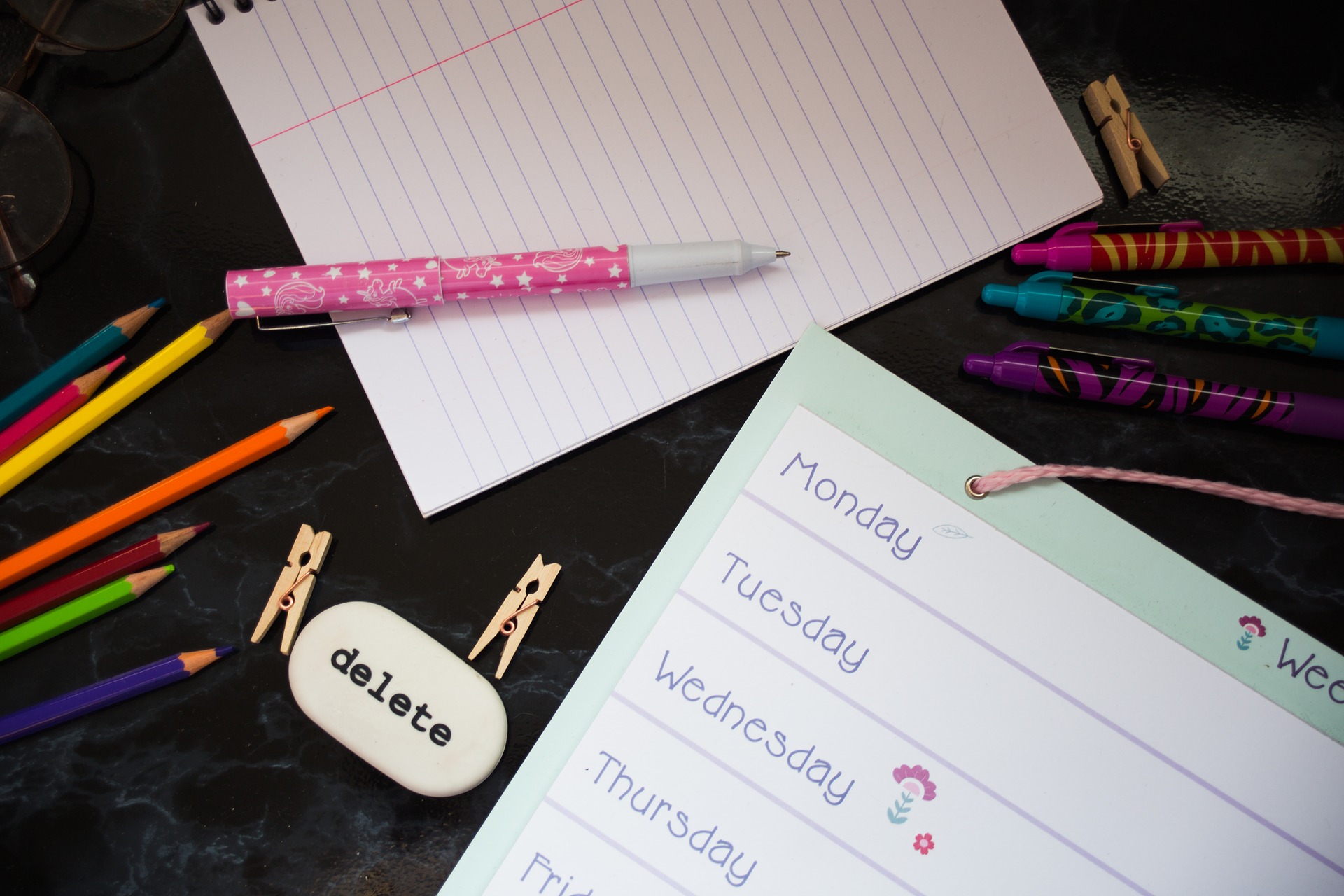
Get organized to get back to school!

Say good-bye beach time, dock time and lazy sunsets late into the evening.  Hello schedules, calendars, assignments and packed lunches. Yikes! Where did that summer go.

Alas, here in North America, and many places around the world, school has just gone back in session after a couple of months of that beautiful thing called Summer Vacation.  however, getting kids and families back to school carries the same challenges  whether your are north or south of the equator.  To help you out, here are a couple of tried and true tips.  They work every time.  Hang in there folks….the holidays are only 10 weeks away.  Don’t worry….we can help with that too!


Keep the Family Calendar Public

Whether electronic or paper, a family calendar is an essential organizing tool.

To help keep the family organized with schedules, a posted, public calendar is helpful. There are several wall/refrigerator calendars available from special Family Organizing ones to white boards. Whichever style suits your families needs, make sure it is posted where everyone can see it. Schedules are best not kept as a secret. Try using an alligator clip on a hook to keep all time sensitive information i.e. Birthday party invitations, curriculum night close at hand. If necessary, use binder dividers to separate the information by family member.

Label, Label, Label

Used permanent marker to make sure lost items come back.

Label everything possible that doesn’t normally stay attached to your child. Label lunch bags on the outside so that they can see their name clearly. Try to have the children wear their new clothes several times before school so that the items are very familiar to them. If you don’t have access to iron on labels, a pen or laundry marker on the tag will serve the purpose.Children are most likely to lose items that they don’t recognize as their own  like all those new back to school clothes, binders and lunch bags.

Home Organizing
organizing the living room

4 Steps to Organize the Living Room and Reclaim Some Adult Space

Posted by Carolyn on
 May 15, 2018

Wish you could reclaim adult space in the living room for?

Are you looking to organize the living room and reclaim  a little of the adult space  again?  Have you stepped on Barbie’s shoes one too many times? Wish you could organize the living room into an adult rest and relax space for just one evening?

Reclaiming adult space is a common theme for many parents.  You love your children. At times, however, there comes a point when many parents crave a lego-free zone, even for just a short period.

Banning Barbie, her shoes and the lego altogether may not be possible, or even desirable, for your family and home.  The living room frequently serves as a multi-purpose space.  In the absence of a large recreation or family room, the living room is sometimes adult relax space, Barbie’s house and lego creation central all at the same time.

Here are 4 steps that you can use to organize the living room to help keep Barbie, the lego and any other toys in check so that when needed, the living room can be the rest and refresh space the adults in your household are looking for.

Step 1 – Identify Easily Accessible Storage Space

Look around and study where you might find storage for toys and other children’s items in the living room.  Storage space, which children can access, can be simple and easy.  Look for space under tables, a shelf on a book shelf, a shelf in an entertainment unit, storage in an ottoman.

organizing the living room

Here is an example of re-purposing a bureau in the living as a table. The drawers make for great toy storage.

Step 2 – Contain the Chaos

Gather up the toys and see what can be parked where.  Identify a new home for the items.  Larger items can go under tables.  Stow smaller items in containers on shelves, under the coffee table or on a book shelf.

Step 3 – Source out Storage Containers Complimentary to your Living Room Decor

Sure, toy storage can be bright and cheerful and kid friendly.  It can also be adult and decor friendly.  While lego may need to be stored in some form of sorting container, the finished products can be displayed with pride on the bookshelves an entertainment unit.  Consider using a glass coffee table with a shelf and the finished lego items become decorations themselves.

Step 4 – Build tidy up time into play time

organize the living room.

Open containers that match the colour scheme of this living room make for perfect toy storage on the bottom of the book shel

Once each item has a home, and the home has been put into place, the next step is to teach the children to use those containers and return their toys, books and lego to their homes.  In my experience, children understand that they go home after playtime so the toys and books also need to go home after play time.  When we teach them that the toys need to go home to after playtime, clean up is done by the kids, not the adults.

Home Organizing Organizing Strategies
Tags : Accumulation, Clearing Clutter, living room, managing mess

Top 3 Tips for an Organized Car

Posted by Carolyn on
 April 18, 2017
  ·  1 Comment

Let’s Get Organized, Car!

Welcome spring with an organized car.  With an organized car, you will be ready, to hit the road this summer!  The warmer weather and clear roads make many of us start to think about smartening up that car.  if you live in Canada, like I do, you’ve just taken off the snow tires, had the car serviced for breaks, oil and whatever else is on its schedule.  Now a car wash is on the agenda for a warm sunny weekend in April.

Once that beauty is clean and purring, what about keeping it clean and organized?  Here are the top 3 tips for you to follow to keep that and smart looking and organized car.

1. Get rid of the Garbage!

Manage the garbage to keep your 4 wheeled baby looking beautiful.  Nothing says, “I’m not organized” like a car full of old fast food coffee cups, bagel wrappers and other debris.  Grab a garbage bag – check through the car and load up that bag. Most of the clutter in cars is associated with garbage that just didn’t make it to the bin.  Kids can help; give them their own garbage bag for their part of the car. Next time you fill up with gas, get them to toss it in the bin.

2. Contain the Car Accessories

Put a box in the back for wandering gear – this can be as fancy as a “car gear box” available at many retailers or as simple as a cardboard box. Toss all the bits and pieces that have to stay with the car in there – cables, hitches, wrenches (for the hitches), roof rack accessories and the like.  This will accomplish two things for you and your car.  First, the car will be clutter free.  Secondly, you will be able to find the accessories when you need them.  Nothing kills the joy of packing for a weekend fishing trip like searching high and low for the hitch ball.

3. Clear the Glove Box

 Our winters are cold.  There were a lot of trips for coffee and tea en route to ski weekends and ski races this winter.  As a result, our glove box gets full of random napkins and, if i’m not watching carefully, ketchup sachets and straws. Those who know me know there will be no ketchup, or any other condiment, sachets in my car.  Take only what you need for those chips. Throw out the rest!  There are lots of napkins and straws that wander into the glove box.  Get rid of the old ones and put in some fresh new ones, along with a fresh package of hand wipes for when water isn’t available.   While you are at it, use the old napkins to wipe of the console and dash of dust and winter debris.

Now the next time you and the family want to hit the road, your shiny, organized car will be waiting in the driveway.

Organizing Travel Top 3 Tips
Tags : Car, organized car, organized travel

Time Tamer Tuesday – 5 Steps to Time Management at the Office

Posted by Carolyn on
 March 14, 2017
  ·  3 Comments

Time Management at the Office

Time Management, The Illusive Goal

Wouldn’t it be nice to know that time management was actually possible? Do you wish you could get more done at the office?

Unfortunately, despite all attempts otherwise, none of us can manage Time; that is the reality.  It continues to tick away – 24 hours in each day, 60 minutes in each hour and 60 seconds in each minute – each and every day of the year.  We can, however, manage ourselves.  We can manage ourselves to do more with the time we have available. Manage your behaviour around getting things done, and time will seem way more friendly – almost like you did manage it. Here are 5 steps to get help you out.

Step 1 – Commit to Behaviour Change as a Time Management Strategy

Start by committing to managing yourself in order to get time management under control.  Set the intention to become more productive with  your time.  With a commitment to your own behaviour change, time management becomes less illusive.  Make a pact with yourself to take responsibility for doing more in less time.  While time is not to blame for what you can’t get done, only  you have control over what you CAN get done.  So take back control.

This is the toughest step.  Get firmly planted in this direction, and the rest will seem much easier.

Step 2 – Identify Your Top Priorities and Tasks for each Day, Week, Month and Year

Time Management at the Office, Set Goals

You likely already have annual priorities identified as part of your annual planning, goals, performance objectives or other performance measurement or company planning strategy.  Are you an entrepreneur?   Have you got your business objectives lined up for the year/quarter/month/week?  Great.  Now turn them into goals for the month, week and day.  What do you need to get done by the end of the day, week, month, and then the quarter, to accomplish your annual goals?  The priority tasks for today will feed into your priority goals for this week.  The same is true for the month.  By the end of this week, are you a quarter of your way to your priorities for the month?  What has to be finished to get there?

Daily tasks are the key to keeping the productivity up.  Keep your daily priority tasks simple and short.  Now write them down.  Start with a verb to direct your action.  Rather than writing “Managers’ Report” write “Collect data, analyze and write Managers’ Report”.   Writing down goals helps set the intention and for many of us, helps lodge those goals into our brains to help keep us focused and pointing in the right direction.

Step 3 – Book Time in your Calendar to accomplish the Tasks

For time management book tasks into your calendar.

Each task takes a certain amount of time.  Estimate this to the best of your ability and book the time to accomplish the task into your calendar.

There’s a funny thing about tasks we want/need/should get done, especially some of the tougher ones.  If we don’t book time and protect that time, everything else, on everyone else’s priority list, has the opportunity to get

Step 4 – Commit to the Time Scheduled – and Let Everyone Know

Your time is committed; tell the people around you.   Close your door.  Ask not to be disturbed.  Put your phone on silent.  Turn off your email alerts. Turn off all your alerts except for any related to risk management that require you to drop everything and respond (are you on the Code Blue Team?).  This often takes some practice.  With time, however, people will come to understand that you commit to your time and expect them to respect that.  And they will love that you get stuff done.  Your boss knows that managing these boundaries helps you to get stuff done for her/him.  Reports are on time.  Your staff recognize that you get stuff done for them.  Schedules are on  time.  You approve vacation requests quickly.

Nice.

Step 5 – Commit to Running Productive Meetings

You’ve got a meeting to run?  Set an Agenda.  Send it out ahead of time.  Be clear on what you are trying to accomplish.  Remember, other people struggle with time management as well.  When you are clear on the agenda, people you meet with are grateful.  Stick to it your agenda.  Finish the meeting just as soon as the agenda is accomplished.  While we are all interested in someone else’s successes, their celebrations and someone else’s venting their frustrations, if all that isn’t on your agenda, it will have to wait for some other time.  You run a focused and productive meeting.


With a commitment to managing yourself, identified priorities, time booked for your key tasks, protection of your time and productive meetings, time management at the office is no longer illusive.  At least it will feel like you managed time.

Office Organizing Organizing Time Time Tamer Tuesday
Tags : organizing strategies, productivity, Time Management, Time Tamers
website launching

Great Day for a Website Launch

Posted by Carolyn on
 February 13, 2017
  ·  No Comments

website launching

What better day than Valentine’s Day to launch a new website.  Have a look around and leave a message.  Sign up for tips, tools and strategies on getting clarity, doing more with less, getting focused, and productivity.

So glad you stopped by. Check us out also on Facebook, Instagram and Twitter.

Caldwell Evolution News
Letters to Clutter

Letters to Clutter: Tell it how you Really Feel!

Posted by Carolyn on
 February 5, 2017
  ·  2 Comments

The Clutter LettersSend me your letters to clutter.  Does this sound like you?

You’re standing in front of your desk, staring at the stacks of paper, frustrated and overwhelmed.  “Why are you still here?  Why can’t you find a file to climb into and make yourself available when I need you?  Somewhere in there is the invoice I’m trying to get paid for – how will I ever get paid if I can’t even find the invoice?”

You open the closet door and glare at the contents.  “I hate you and I love you.  Ugh, how am I ever supposed to make this closet work when a bunch of you don’t fit, some of you I don’t even like and I don’t even know what’s at the back?!”

Your youngster is finally in bed and hopefully soon asleep.  You return to the family room and flop into the chair realizing you can’t even walk on the floor any longer because of the piles and piles of toys.  “Just put yourselves away, why don’t you! “Can’t you find a nice basket or box and do the Mary Poppins thing – jumping right into them?  And while you are at it, sort yourselves out and take the toys that no one has played with for the past 6 months to the donation centre.  I’m going to bed.”

If you’ve ever talked to your clutter, or think you might like to say something to it, I’d like to hear from you.  Consider writing a letter or letters to clutter and tell it how you really feel.

Why Letters to Clutter?

You letter or letters to clutter will be considered for inclusion in a project being published later this year.  Your letter doesn’t need to be long, 200 – 400 words is perfect although longer or shorter is also welcome.  Start your letter off with “Dear ________ (item or items of clutter i.e. Paper, Baby Clothes, Garden Tools), What am I going to do with you?” and tell the clutter what you are really thinking.

Types of Clutter

Your clutter might include one of the following items or you might have your own version of clutter.:

  • Costume jewelry
  • Inherited jewelry
  • Inherited dishes, flatware, glass/crystal
  • Paper
  • Sports equipment
  • Particular sports equipment e.g. A bag of balls, an old croquet set, a bag of hockey equipment
  • Clothes that don’t fit
  • Clothes that aren’t liked
  • Clothes in general
  • Childhood books
  • Memorabilia
  • Photographs
  • Someone else’s items e.g. a spouse’s sports gear, clothes or other items
  • Tools
  • Leftover renovation material e.g. tiles, paint, fabric
  • Craft goods

How and Where to Send you Letters to Clutter

Identify yourself only by your initials and your town of residence.  Individuals will not be identified in their submissions and any particular identifying information will be removed.

Send letters to me, Carolyn Caldwell at carolyn@caldwellevolution.com.

Looking forward to receiving your letter or letters to clutter and seeing what you have to say to those trinkets collecting dust on the shelf.

Organizing Challenges Organizing Resources Organizing Strategies
Tags : Accumulation, Clearing Clutter, clutter, Letters to Clutter, managing mess, managing overwhelm, Overwhelm
Letters to Clutter

Letters to Clutter

Posted by Carolyn on
 February 5, 2017
  ·  No Comments

You’re standing in front of your desk, staring at the stacks of paper, frustrated and overwhelmed.  “Why are you still here?  Why can’t you find a file to climb into and make yourself available when I need you?  Somewhere in there is the invoice I’m trying to get paid for – how will I ever get paid if I can’t even find the invoice?”

You open the closet door and glare at the contents.  “I hate you and I love you.  Ugh, how am I ever supposed to make this closet work when a bunch of you don’t fit, some of you I don’t even like and I don’t even know what’s at the back?!”

Your youngster is finally in bed and hopefully soon asleep.  You return to the family room and flop into the chair realizing you can’t even walk on the floor any longer because of the piles and piles of toys.  “Just put yourselves away, why don’t you!  Can’t you find a nice basket or box or anything and do the Mary Poppins thing – jumping right into them.  And while you are at it, sort yourselves out and take the toys that no one has played with for the past 6 months to the donation centre.  I’m going to bed.”

If you’ve ever talked to your clutter, or think you might like to say something to it, I’d like to hear from you.

Write your clutter a letter and send it to me for inclusion in a project being published later this year.  Your letter doesn’t need to be long, 200 – 400 words is perfect although longer or shorter is also welcome.  Start your letter off with “Dear ________ (item or items of clutter i.e. Paper, Baby Clothes, Garden Tools), What am I going to do with you?” and tell the clutter what you are really thinking.

Your clutter might include one of the following items or you might have your own version of clutter.:

  • Costume jewellery
  • Inherited jewellery
  • Inherited dishes, flatware, glass/crystal
  • Paper
  • Sports equipment
  • Particular sports equipment e.g. A bag of balls, an old croquet set, a bag of hockey equipment
  • Clothes that don’t fit
  • Clothes that aren’t liked
  • Clothes in general
  • Childhood books
  • Memorabilia
  • Photographs
  • Someone else’s items e.g. a spouse’s sports gear, clothes or other items
  • Tools
  • Leftover renovation material e.g. tiles, paint, fabric
  • Craft goods

Identify yourself only by your initials and your town of residence.  Individuals will not be identified in their submissions and any particular identifying information will be removed.

Letters can be sent to me, Carolyn Caldwell at carolyn@caldwellevolution.com.

Looking forward to hearing what you have to say to those trinkets collecting dust on the shelf.

Caldwell Evolution News
Tags : Caldwell Evolution, Clarity, Frustration, Letters to Clutter, Overwelm, The Clutter Letters

Welcome to the Caldwell Evolution Website!

Posted by Carolyn on
 February 1, 2017
  ·  1 Comment

Caldwell EvolutionIt’s official: February is a wonderful month to publish a new website.  So here it is.  Cruise around and having a look at what the new site is about.


Where could your Evolution take you? Find out with coaching for clarity and purpose. Time for new website

Where could your Evolution take you?

If you are interested in Coaching?

Do you want to achieve more clarity in your goals?

Are you a professional organizer looking to kick start your organizing business into action? You will be interested in checking out the Evolution Coaching page.


If you are interested in achieving greater organization in your home, life or business, you will be interested in checking out our professional organizing services.



Professional organizers check out the Organizing Summit page for updates on the latest trends in the organizing industry.



Caldwell Evolution News Mindfully I AM Evolving Coaching
Tags : Caldwell Evolution, Clarity, Coaching, Evolution Coaching, Evolve, Mission, Organizing Summit, Professional Organizing, Vision
organized Garden Shed

The Path to an Organized Garden Shed

Posted by Carolyn on
 May 10, 2016
  ·  1 Comment
organized Garden Shed

An organized garden shed can make gardening easier and more fun.

Spring has arrived in the northern hemisphere, and with it, the promise of brightly coloured flowers, overflowing planters and fragrant fruit trees.  If you have a piece of property, chances are you also have a garden of some size and complexity and likely a shed to house the tools.  So, along with turning the soil, top-soiling the grass and trimming the roses, why not set up for an organized garden shed as well?

No more fishing around for tools you thought you had, can’t remember if you lent out and need for trimming that Euonymus.  Here’s a step by step process to get you off on the right path.

Step 1 – Empty the Shed

Start by completely emptying the entire shed if feasible. Once it is empty, you will be able to start with a clean slate.  You will also be able to see what you have and inventory your tools and their condition.

Sweep out the cobwebs, mouse droppings and other debris.

Step 2 – Inventory and Assess Your Tools

Review all your tools, shovels, rakes and hoes. Are there any that are broken, rusted or beyond repair? Throw out the irreparable and fix what’s needed.  Are there any that are redundant, never used and could use a better home with someone else?  Keep only those tools that you know you will use. With an organized garden shed you will also be able to find them quickly and easily.

Step 3 – Get Creative Garden Shed Storage and Give Everything a Home

Think vertical and you will find lots more fresh storage space that you may not have realized existed. Use your creativity to organize your garden shed. The rakes, hoes, shovels can be stored on hooks or nails on the walls. This will get them out of the way and make them readily available when you are ready to rake.  If you have the funds, many garden or home supply stores sell mountable devices specifically designed for hanging gardening tools such as rakes.  If you are looking to organize using limited or no funds, use straight nails for hanging rakes, hoes, shovels and almost everything in the shed.  Have some fun seeing how many tools you can actually hang for storage.

Hang one shopping bag on another hook or nail to hold your digging and planting tools and a separate one for your garden gloves. Cloth grocery bags, made from recycled plastic bags and readily available in stores, are a great storage tool. Label with a permanent marker or bright fabric paint.  An alternative to hanging gloves and hand tools is to repurpose a wooden wind rack as a tool rack.

Items that are used on a daily basis or frequently during the week can be stored near the door on easy hooks or readily accessible shelves.  Think secateurs for deadheading roses, trowel for pulling or upending weeds.  Keep your garden gloves on the same shelf or hook beside – your tools are easy to grab for a quick 10 minutes of deadheading flowers each day.

Step 4 – Hide the Seeds from Wannabe Snackers!

Rodents and small animals would be delighted if you would just leave all those seeds out where they can help themselves.  Let the squirrels find their own nuts and pack up the seeds to limit their scent and make it hard for animals to get access.  Seeds that are stored in a plaster or metal box will be out of temptation’s way if rodents are a regular visitor to your shed. This is especially true of grass seed.

Step 5 – Keep Solutions Legal and Out of Reachshovels, spades, rakes hanging on side of shed

Review your solution bottles and know your pesticide by-laws. Many, if not all, jurisdictions have outlawed the use of pesticides. Check with your municipality to see where you can take the pesticides for disposal. Then check out your local garden centre to find an environmentally friendly alternative.

Even environmentally friendly products must be kept out of reach of children.  Make sure your organized garden shed includes shelves high enough that curious children can’t get into solutions, anti-fungal products and plant food.  Garden shed shelves, like tool hanging devices, can be expensive and fancy or inexpensive and simple.  Most home supply stores carry industrial shelving of various sizes and strengths.  Make sure to check the weight capacity, usually listed on packaging by individual shelf.  If your shed is metal or plastic, you may be limited to commercial standalone shelves.  With a wood shed, simple shelves can be constructed between the joists.

Step 6 – Use your Organized Garden Shed

An organized garden shed is easy to use and supports your interests in the garden.  Try taking your shed for a test run.  Can you easily find the tools you need?  Can you just as easily put them away?  Arp – e your daily use tools where you can get at them?  Are the seeds safely sealed away from intruders?  Have you kept only what you use and what you need?

Last step – as always, enjoy the fruits of your labours and the bounty of your garden.

Home Organizing Organizing Strategies
Tags : organized shed, outdoor organizing
golden retriever dog holding newspaper in his mouth

So Much Recycling!

Posted by Carolyn on
 April 12, 2016
  ·  No Comments

“I didn’t know there was so much recycling!”two people putting plastic bottles into a recycling bin

This is the exclamation of almost every client when we start to clear out the clutter.  When clients are downsizing, the pile of recycling and other cast off material gets bigger and bigger and bigger.

It is somewhat inevitable.  Living in one home for many years, sometimes decades, can lead to such a build up in clutter and unused belongings that we just basically forget about. We end up purging out a significant amount of material that can not be re-purposed, is not suitable for sale or donation and therefore ends up in either the garbage or recycling. When clearing out a space, even just to reorganize to make the space function better, clients are often surprised how much debris has collected over the years which ends up no more valuable than the garbage or recycling bin.

Downsizing Quick-start

Are you looking for a quick way to start downsizing? Start your project armed with information about how to get rid of large piles of garbage or recycling. Some of the material can go to your regular garbage pick up or disposal although most jurisdictions now carry volume limits on the service. Check into your service provider, public or commercial to find a) volume limits b) size limits or c) alternate places where you can take the material yourself. Most of these places will have a tipping charge. In the jurisdiction where I live, this charge is $10 per 100 kg or part thereof.

If you know there is going to be huge amount of material to garbage, consider a junk removal company. In addition, you will need to have a “staging” area where the goods heading to garbage can be put while you continue to clear out your space.  For recycling, check into the requirements to sort the recycling into different elements such as metal, paper and plastic.

Open Mail over the Recycling BoxRed mail box beside window of stone house. window box with plants on window ledge

If you want to avoid the accumulation, learn to process your paper with a paper recycling box nearby.  I encourage clients to literally open their mail over the recycling box or bag.  In most cases, there is very little mail left over when the recycling has been taken out.  For starters, just removing the envelop and inserts can reduce the paper.  Discarding these items as soon as they enter the house, will help to keep the paper clutter to a minimum.  It also means less paper to house and manage.

“Even precious treasures left long enough, become garbage“.
One of my favourite client quotes.


Home Organizing Move Organizing
Tags : clutter, Downsizing, Paper, recycling
← Previous Page
Next Page →

Banish those procrastination gremlins!

Conquer Procrastination Cheat Sheet

Struggling with procrastination gremlins? Grab your free copy of Conquering Procrastination Cheat Sheet: 4 Procrastination Gremlins and the Tricks to Beat Them.

This field is for validation purposes and should be left unchanged.
Name(Required)
Caldwell Evolution | Copyright © 2026 All Rights Reserved
Website by Janet Barclay